05.02.2013

Winter 2011 Concubine Oolong from Dong Ding (Tea Masters)


After a long (but intriguing) stretch of sheng filled days, I got an acute craving for Oolong.
In  a previous entry I described how a Winter harvest of a Taiwanese High Mountain Oolong made me change my opinion of that type.
Nach einer langen (aber faszinierenden) Folge von Sheng-Tagen, bekam ich ein plötzliches Verlangen nach Oolong. In einem früheren Eintrag habe ich beschrieben, wie ein taiwanesischer Hochland Oolong (Gaoshan) aus der Winterernte es schaffte, meine Sicht der Gaoshan-Tees umzukrempeln.

Today I picked a Winter harvest of an Oolong type I love all year around: Concubine Oolong.
Heute wählte ich die Winterernte eines Oolongtyps, der mich das ganze Jahr hindurch begeistern kann: Concubine (Guifei) Oolong.

For all of you who have not tried a Concubine Oolong before, I recommend Stéphane's blog, where (click) he has written in detail about this type and the specific tea I am enjoying right now.
Für alle, die noch keinen Guifei Tee kennen, empfehle ich Stéphanes Blog, wo er hier ganz genau beschrieben hat, was man über Herkunft und Verarbeitung meines heutigen Tees sagen kann.
 
The tightly rolled leaves look pretty dark. Not the darkness of excessive roasting or the oxidation found in Oriental Beauty. More a green which has become so concentrated that it strains the definition of 'green'. In the preheated pot the leaves emit a fragrance that has sweet fruity, heady flowery and even some slightly spicy notes (just a hint of nutmeg ?).
Die eng gerollten Blätter sehen ziemlich dunkel aus. Nicht die dunkle Farbe übermäßiger Röstung oder die weit vorangeschrittene Oxidation von Oriental Beauty Tees. Es wirkt mehr wie ein Grün,  das so konzentriert ist, dass es die Definition von Grün am dunklen Ende verlässt. Im vorgewärmten Kännchen geben die Blätter einen Duft frei, der süß-fruchtige, betörend blumige und leicht würzige Noten hat (ist da hinten nicht ein Hauch Muskat?).


Let's see how the liquid turns out.
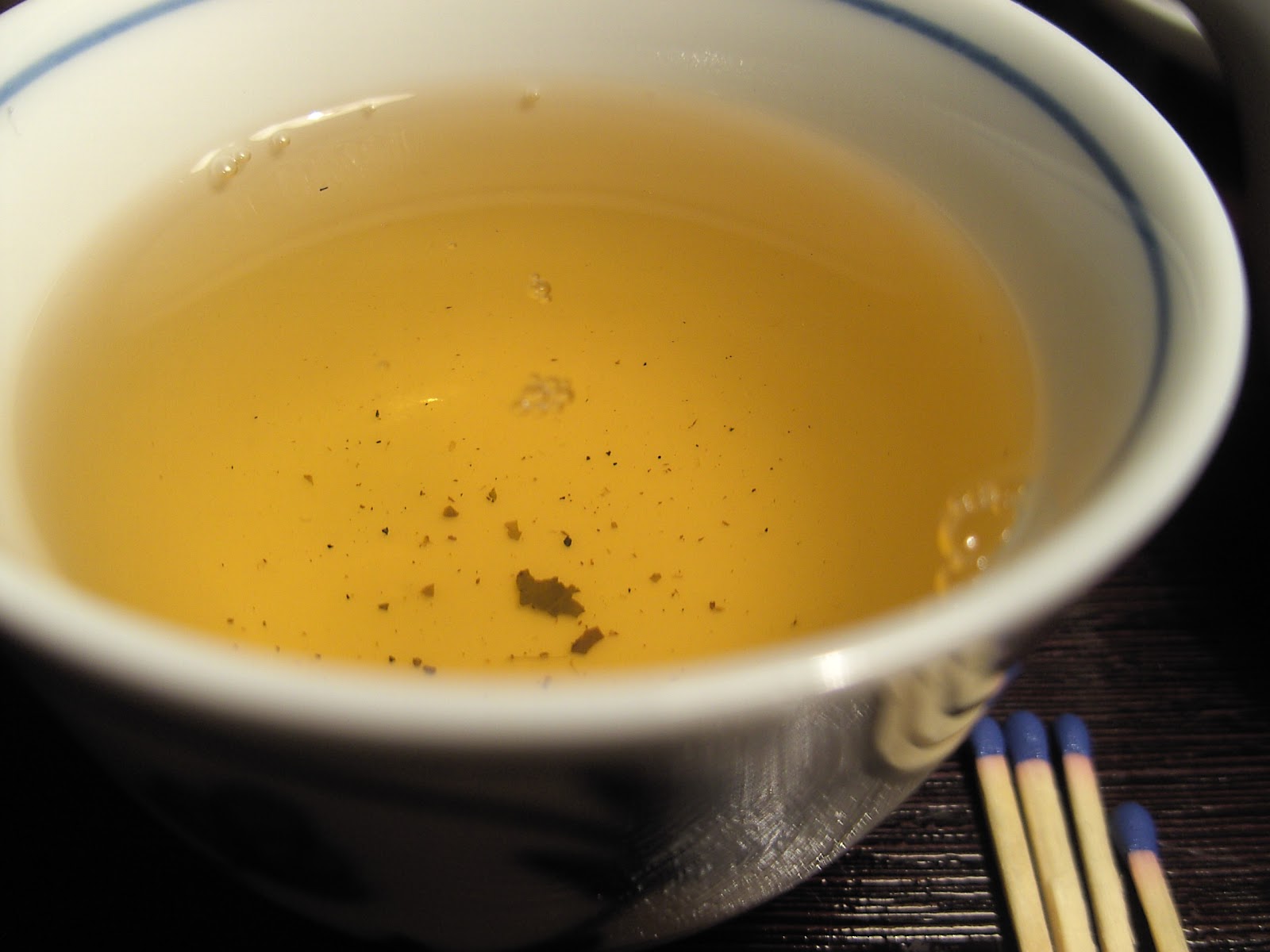
Have to admit, I was too stingy with the leaves. Flavourwise, the brew turned out really thin. My wife enjoyed it - which means the taste is far below the intensity I usually go for. But what a mouthfeel! This is what I imagine liquified silk would feel like - heavenly.
Wenden wir uns mal dem Aufguss zu.
Ich muss zugeben: ich war zu geizig mit den Blättern. Geschmacklich fiel das Ergebnis wirklich dünn aus. Meiner Frau gefiel der Tee - ein eindeutiges Indiz für mich, dass der Tee viel schwächer war, als ich es gern habe. aber dieses Mundgefühl! So stelle ich mir flüssige Seide vor - himmlisch.


A look inside the pot reveals that I have really not used enough leaves. My ideal is to have (after 3-5 infusions) a pot filled with unfurled leaves - the leaves not being stuffed but just filling the pot up to its lid.
Ein Blick ins Kännchen offenbart, dass ich tatsächlich zu wenige Blätter verwendet habe. Mein Ideal ist ein Kännchen, das nach 3-5 Aufgüssen gefüllt ist mit gequollenen Teeblättern - bis zum Deckel aber ohne beengt zu sein.


To make up for this I started to 'push' the leaves early on. Even when infused for the entire length of Marillion's 'Kayleigh', it still tasted smooth and utterly pleasing.
Um diesen Mangel auszugleichen, fing ich recht früh an, den Blättern einiges abzufordern. Aber selbst wenn ich den Tee über die ganze Länge von Marillions "Kayleigh" ziehen ließ, schmeckte er immernoch weich und rundherum erfreulich.


The spent leaves are looking nice and healthy. Oxidation seems to be evenly distributed throughout the leaves and roasting can be detected in the leaves' unwillingness to unfurl completely to their natural shape. Yet the roasting is mild enough to just add to the tea's flavour and rounding it off - not dominating it.
Die ausgelaugten Blätter sehen schön und gesund aus. Die Oxidation ist ziemlich gleichmäßig durch das Blatt hindurch verteilt. Die Röstung lässt sich daran erkennen, dass die Blätter nicht so ganz bereit waren, wieder ihre ursprüngliche Form anzunehmen. Aber die Röstung ist mild genug um dem Geschmack nur eine weitere Dimension zu verleihen und abzurunden - es ist keine dominante Röstung.

A pleasant and relaxing tea - even when brewed "too little (quantity of leaves) too late (poured into cups)".
Might be a great way to be introduced to Taiwan Oolongs: not as greenish as some Gaoshan, not as dark as Oriental Beauty ... and unable to hide its quality, even when brewed as inadequately as today.
Ein angenehm entspannter Tee - selbst wenn man ihn zu schwach dosiert und zu lange ziehen lässt.
Vielleicht ist dies genau der richtige Tee, um Oolong-Einsteiger mit Taiwans Teewelt vertraut zu machen: nicht so grünlich wie Gaoshan, nicht so nah am Schwarztee wie Oriental Beauty ... und nicht in der Lage seine Qualität zu verbergen, selbst wenn er so unzulänglich bereitet wird wie diesmal.

02.02.2013

Longrun Zhongmu 2011

Today will be another tea from the round of Sheng which Chris (Chenshi-Chinatee) stocked on special request by Teetalk.de teafriends.
Heute beschäftige ich mich mit einem weiteren Tee aus den Neuzugängen im Sheng-Bereich von Chenshi-Chinatee, die Chris mit den Teefreunden von Teetalk.de ausgewählt hat.

Longrun Zhongmu 2011 (shop link)
6g in 80ml gaiwan - this might turn out to be on the rough side!
6g im 80ml Gaiwan - das könnte etwas heftig ausfallen!

To get you in the mood for this session I suggest you enjoy this Youtube clip "Liam" performed by In Extremo (take a good look at the picture):
Um sich auf die die heutige Session einzustimmen empfiehlt es sich, erstmal diesen Youtube Clip zu genießen: "Liam" von In Extremo (das Bild im Video passt bestens)


Dry leaves:
Tightly compressed 100g xiaobing (mini cake) made of varied leaves: some quite big, many smaller ones; some brownish, mostly dark green. A few attractive silver buds and hardly any stalks. Fragrance: deep, dark with a more than generous helping of fresh tobacco.
Trockenes Blatt:
Fest gepresster 100g Xiaobing (Minikuchen) von unterschiedlichsten Blättern: einige recht groß, viele kleinere; einige bräunlich, überwiegend dunkelgrün. Ein paar attraktive Silberknospen und kaum Stängel. Duft: tief, dunkel mit einer mehr als reichlichen Ladung frischen Tabaks.
 20g - my share of the xiaobing / 20g - mein Anteil des Minikuchens


Due to its tight compression, I had to be unusually forceful in prying loose today's bit of tea. This resulted in many broken leaves and tiny fragments - or were there many fragments in the raw material? When I poured off the rinse, it looked as if I had emptied a teabag in my gaiwan.
Wegen der festen Pressung musste ich mit ungewöhnlich viel Kraft die heutige Portion herauslösen. Daher hatte ich viel Bruch und winzige Fragmente - oder war das Rohmaterial von vornherein mit sovielen Fragmenten versetzt? Als ich die Spülung abgoss wirkte es, als hätte ich den Inhalt eines Teebeutels im Gaiwan gehabt.

Wet leaves after rinsing: still solid chunks now clearly showing many fragmented leaves (fannings). Though the looks are - to be quite frank - an utter turn off, I really dig this fragrance. Nothing my wife would understand, as I get notes of rustic tobacco, barn and some barbecue sauce. Nothing flowery sweet and delicate, but a down-to-earth solidity and brutish shenginess.
Feuchte Blätter nach der Spülung: noch immer sehr feste Nuggets, die deutlich fragmentierte Blätter (Fannings) zeigen. Obwohl das Aussehen - um es ganz ungeschönt zu sagen - eine ziemliche Enttäuschung ist, bin ich vernarrt in diesen Duft. Nichts, was meine Frau nachvollziehen könnte, denn da sind ganz robuste Tabaknoten mit Scheunengeruch und Barbecuesauce. Nichts Blumiges oder Zartes, sondern bodenständige Solidität und eine brutale Shengigkeit.

First two infusions: greenish yellow. Taste is somewhere in between Gun Powder green tea and an unlit pipe filled with Mac Baren Mixture (one of my regular unflavoured tobaccos back in the smoking days). And in the background an unostentatious sweetness to round the flavours off, giving body to the brew.
Ersten zwei Aufgüsse: grünlich gelb. Geschmacklich irgendwo zwischen grünem Gun Powder Tee und einer frisch gestopften Pfeife mit Mac Baren Mixture (ein unaromatisierter Tabak und einer meiner Standards früher in Pfeifenraucher Jahren). Und im Hintergrund eine unaufdringliche Süße um es abzurunden und Körper in die Tasse zu bringen.

Third infusion: now we have taken our vessel to rougher seas! Seems the chunks have opened up, releasing a gale of intense shenginess. This ain't no sunshine girly tea, this is like a wave crashing into your face while you try to keep a grip on the railing. Oh, how sweet the salty sea can be to a sheng faring sailorman!
Dritter Aufguss: jetzt sind wir in rauhere Gewässer gekommen! Scheinbar haben sich die Nuggets geöffnet und nun bläst mir die volle Shengigkeit in Sturmböen um die Ohren. Dies ist kein mädchenhafter Schönwettertee, dies ist eine Woge, die einem ins Gesicht kracht während man sich verzweifelt an die Reeling klammert.
The sun came out and totally changed the colours

Fourth infusion: had to dillute this one was water. Still the mouthfeel is delightfully f u l l and lingering. All my mouth and sinus cavities feel alive and pleasantly tingling. And like a good Islay Malt Whisky the tea leads to a warmth rising from my chest, entering my mouth and enhancing the lingering sweetness.
Vierter Aufguss - den musste ich etwas verdünnen. Aber das Mundgefühl ist auch nach dem Verwässern noch herrlich v o l l  und lange anhaltend. Mein gesamter Mund- und Nasenraum fühlt sich angeregt und prickelt angenehm. Wie bei einem guten Islay Malt Whisky bringt dieser Tee eine Wärme mit sich, die von der Brust aufsteigt, in den Mund eindringt und die nachklingende Süße belebt.


I've come to the eleventh infusion without writing down notes on the way. Just some enjoyment in quietude - to counterbalance the turbulent and lively tea. While I was pleasantly slapped in the face to earn sweet huigan, I had a visitor: our cat Jula came to sit in my lap. To put this into perspective: this happens about twice a year - usually when I am fully absorbed by an outstanding tea. So one might say this tea has been granted the highest praise by a very strict auditor.
Bis zum elften Aufguss ohne weitere Notizen. Einfach nur genießen in Stille - als Gegengewicht zu diesem turbulenten und lebhaften Tee. Während ich mir vergnügt geschmackliche Gesichtsklatscher gönnte um dafür den süßen Nachgeschmack zu bekommen, bekam ich Besuch: unsere Katze Jula kam auf meinen Schoß. Um das mal in die richtige Perspektive zu setzen: das passiert nur. ca 2mal im Jahr - typischerweise wenn ich von einem herausragenden Tee völlig gefesselt bin. Man kann sagen, dass dieser Tee eine sehr kritische Prüferin überzeugt hat!

(pictures from a past session where the auditor had no patience with the camera. She had come for serious business and I should concentrate on the tea too.)

The twelfth infusion feels a bith thin at first - there seems to be less sweetness. But in the aftertaste my mouth was flooded by sweet licorice. While doing the fifteenth infusion (6 minutes) I thought about finishing the session. But then came the aftertaste. After a rather bland taste there was a huigan (literally a 'returning sweetness') that convinced me to give it another go.
Der zwölfte Aufguss fühlte sich zuerst etwas dünn an - wohl weniger Süße. Aber im Nachgeschmack kam eine Flut süßer Lakritze. Während des fünfzehnten Aufgusses (6 Minuten Ziehzeit) überelgte ich, für heute Schluss zu machen. Doch dann kam der Nachgeschmack. Nach einem anfänglich faden Geschmack war da ein huigan (wortwörtlich eine 'wiederkehrende Süße') der mich überzeugte, noch weiter zu machen.
Binary Match Infusion Counter says: 13

Twentieth infusion: mild, calm - boring. We have braved the stormy seas and come to port. No exitement - just a very week reminder of past pleasure. Time to call it a night.
Zwanzigster Aufguss: milde, ruhig - langweilig. Keine Aufregung mehr - nur noch eine leichte Erinnerung an vergangene Freuden. Der Tee und ich haben die stürmische See herausgefordert und überstanden - jetzt ist der Hafen erreicht und die Reise zu Ende. 
BMIC=20 - I had to add a digit for counting beyond 15


Spent leaves: let's not beat around the bush - they look like rubbish! Mostly broken and shredded - as if they had been a long way down the road to becoming pesto. If I had seen a photo of this messy slop in advance, I'd never have asked for this tea. But that would have bereft me of this truly wonderful tea session.
Schlussbetrachtung der Blätter: da braucht man nicht lange drum herumzureden - die Blätter sehen schrecklich aus! Zum größten Teil gebrochen und zerfetzt scheinen sie nicht mehr weit davon entfernt, als Pesto durchgehen zu können. Falls ich ein Bild dieser Matschepampe vorher gesehen hätte, wäre mir dieser Tee nicht ins Haus gekommen. Aber was für ein wundervolles Erlebnis hätte ich dann verpasst!


My egoism has knocked out my good manners and taken over for writing this
Conclusion: please do not buy this tea! Please do not increase demand for this mini bing! The price for this tea should remain as low as possible, so I can afford to have this tea daily!
Oh to drink this tea and dream of being aboard a tea clipper like the famous Cutty Sark, there to ride out a storm and keeping warm with a good helping of this Zhongmu.

Mein Egoismus hat mal eben meinen Anstand k.o. geschlagen um hier das Fazit zu schreiben: Bitte kauft nicht diesen Tee! Bitte steigert nicht die Nachfrage! Der Preis sollte so niedrig wie möglich bleiben, damit ich mir täglich diesen Tee leisten kann! Hach ... diesen Tee zu trinken und zu träumen - dass ich anbord eines Teeklippers wie der berühmten Cutty Sark wäre und auf ihr einen Sturm ausreite ... um mich hinterher mit einer guten Portion des Zhongmu wieder aufzuwärmen.

Dear readers, thank you once again for bearing with my lengthy ramblings. Might be a nice tea buzz made me too happy to care about exhausting your patience.
Liebe Leser, vielen Dank wiedereinmal für die Geduld mit meiner Langatmigkeit. Mag sein dass ein schöner Teerausch mich zu glücklich gemacht hat, um an die Grenzen Eurer Geduld nach zu denken.

Any ideas where this tea might come from? I'd guess it is a factory made plantation tea - can anyone confirm?
Habt Ihr Ideen, woher dieser Tee kommt? Ich würde drauf tippen, dass es ein industriell hergestellter Plantagentee ist - kann das jemand bestätigen?

26.01.2013

Dayi 8582 (2011) - first encounter

On the German internet tea forum teetalk.de our teafriend and vendor Chris (Chenshi Chinatee) asked us for our opinions on further Puer teas to expand his range. One of our choices was the Haiwan Tuocha which I tried in my last recorded session (previous blog entry). And another addition to his range became the topic for this post.

Today I'll write (as you've all seen in this entry's title) about a Dayi Classic: 8582.
According to the wrapper's batch number it is from the third batch pressed in 2011.


The day before yesterday I brewed it in a gaiwan and for comparison it was brewed in my zisha pot today. Both vessels have a capacity of 100ml and I used 5g pried from my share of the bing.


Before we get to the different results of these sessions, lets have a look at the leaves first.
In the bing (which seems pressed rather firmly) there are some stalks and stems to be found: the bigger guys hidden inside and the tender slender ones on the surface. Hardly any silvery buds or downy hair on bigger leaves. The blended nature of this tea expresses itself in the leaves' appearance: Darkest green with some brown and even copper. Bigger leaves on the surface, some tightly rolled while others resemble wide Japanese Bancha leaves.
I like this bing's looks, but I know it will never be a beauty queen.
When put in the preheated vessel, the leaves emit a fragrance of ... sheng puer! There is no trace of smoke, but a salty-savoury aroma and the heavenly fragrance of grilled bell peppers. After rinsing, the fragrance of grilled bell peppers gets company: olives, sherry and wet hay all join the olfactory enjoyment.
My share of a bing Chris split up between 5 of us teetalkers


Now, lets start drinking some tea! First off the gaiwan:
First infusion gives a clear golden yellow cup with just a bit of greenish tint. Strange that a brew so lightly couloured appears so viscous, oily I should say. The first cup has a light taste (gee - that's going to change!) which is hard to put in words. When I refill my cup from the pitcher, the tea has changed to an orange tinted yellow and the taste seems intensified and sweeter. The primary taste impression is that of camellia sinensis with a bit more, which I can not put in words. This enigmatic taste lingers quite long after swallowing, leaving the roof of my mouth and the tongue somehow activated / alive.


Lets turn to the zisha pot's 1. infusion:
Not really fair to compare it to the gaiwan version, as I encountered a major 'blocked spout syndrom' and thus oversteeped the tea considerably. It started as expected: extremely fullbodied with heavy adstringency. An oily mouthfeel and an intense 'deep' taste.
Please allow me a digression to clarify my vocabulary: I use 'deep' and 'high' to describe taste and smell sensations. Dian Hong, Da Hong Pao and Gyokuro are teas I'd describe as 'deep' - while Darjeeling First Flush, modern Tie Guan Yin and Genmaicha are 'high' teas in my book.
Through all the adstringency in this infusion I got convinced that this tea would turn out really well rounded later on.
This is what happens if the camera is set to "lightbulb" but is used in sunlight
To cut things a little shorter some raw impressions I wrote down throughout the gaiwan-session:
"Intense and orange - is this really as young as 2011? Salty and tobacco flavour - and in the background some cane sugar and mirabelle plums." (2nd infusion)
"This is not a tea like an evening with Hermann Hesse and white wine - rather Charles Bukowski and whisky"
"Full favoured sheng - no girly brew. No smokyness, no licorice, no Bulang bitterness to be found - yet 100% masculine."
"This is no enchanting beauty which makes you fall hopelessly in love with her! This is your buddy and friend, the guy that still understands you at the far end of a whisky evening - even in silence."
During the first infusions I was listening to Chopin. But soon I picked other music and found Tom Waits to give the right soundtrack to 8582. My suggestion: 'Drunk on the Moon'
After 14 infusions I called it a night - the tea was spent.


How about the zisha-version?
"Not a revelation, but this tea just feels RIGHT" (3rd infusion)
"Concentrated taste of camellia sinensis. Slightly sweet, oily and round. Some licorice root which gets more pronounced in the aftertaste." (4th)
"My buddy tea returns"
There was a drop during infusions 8-11. I feared the repeatedly blocked spout had overly worn out the tea early on, but with extremely long infusions (5min +) it came back to life from infusion 12:
"Body - depth - harmony"
Once again the tea was exhausted at infusion number 14.
To show you how much the zisha pot mellowed this tea: instead of Tom Waits the soundtrack for the second session was Loreena McKennitt.

Back to the tea leaves: after the sessions they looked exactly what I expected from a mass product: torn and rather small. But so what - I enjoyed the tea. Like my best friend, whom I like to spend time with, no matter what he looks like.


What did I learn from these two session?

1) It is hard to discuss the nature of a tea if the participants of the discussion are using different pots.
2) A plantation blend can be a good buddy
3) Once you've started fiddling with your camera's setting, remember to reset them.

As my parting question I would like to ask you, if you can verify something I read somewhere (without recalling the source for this information):
Is the blend 8582 made up of maocha from the two years preceeding the bing's pressing?
To be more precise: Is this 2011 bing made up of maocha from 2010 and 2009?

The bing looks so much darker than I would expect from a 2011 tea - a blend containing leaves from 2009 might explain this.

22.01.2013

Haiwan Jiaxi 2007

Dear English speaking readers: sorry, this entry will be in German only. Might make up for the last post which was only in English.

Heute hatte ich zum ersten Mal seit langer Zeit einen Tuocha, nämlich den im Titel schon geannten Jiaxi aus dem Hause Haiwan von 2007. Auf dem Forum www.teetalk.de hat uns Chris von Chenshi-Chinatee mitbestimmen lassen, welche neuen Puer er in sein Sortiment aufnimmt. Dazu gehört auch dieser Tuocha: Link zum Produkt im Shop mit schönen Bildern.

Von meiner ca. 20g-Probe habe ich genau 5g abgetrennt, um dieses Nugget im 100ml Gaiwan zu brühen. Ich war erstaunt, dass ich das Tuo-Stück mit einem Bambusspieß zerteilen konnte - ich hätte mit einer betonfesten Pressung gerechnet.
Links: für diese Session -  rechts: erschreckend geringer Rest


Weil es schon spät ist hier mal einfach hereinkopiert meine Verkostungsnotizen, wie ich sie während der Session festgehalten habe:


Trockenes Blatt:
Im gar nicht mal so megafest gepressten Tuo dunkelgrün-bräunliche Blätter. Ein paar Stängel, ein paar Tips und scheinbar keine besonders großen Blätter.
Duft im vorgewärmten Gaiwan wie … Erdbeermarmelade? Nur ganz flüchtig, danach intensiver Duft nach TEE, etwa Salz und würzige Landwirtschaft. Und wie ein Nachduft (analog zum Nachgeschmack) doch noch etwas Erdbeermarmelade.

Infusion nach Spülgang:
Noch immer sehr dicht gepresstes Nugget – dunkelgrüne bis bräunliche Blätter, fast wie eine Mischung aus Gyokuro und Herbstlaub. Im Duft noch stärker ausgeprägt: hier scheint jemand Erdbeermarmelade zu kochen.

1. Aufguss:
Noch sehr dünn und blass – das Nugget muss sich noch mehr öffnen. Geschmack – Chris, warum jubelst Du uns aromatisierten Tee unter?! Seit wann wird Erdbeertee mit Zuckersirup zusammen zu Tuocha gepresst? Nur Quatsch, der Tee ist ganz pur, aber die Süße und Fruchtigkeit ist verblüffend. Oft wird bei Sheng von Huigan gesprochen – dem Effekt wenn die anfängliche Bitterkeit nach dem Schlucken in Süße umschlägt … aber dieser Tee spart sich die Bitterkeit und ist gleich von Beginn an süß und fruchtig. Da ist im Hintergrund etwas von Salz und Heu (Silage) – das lässt mich nicht daran zweifeln, dass ich hier einen Sheng trinke.


2. Aufguss:
Fruchtigkeit tritt etwas zurück – der Tee wird etwas weniger mädchenhaft. Nun zeigt sich ein vollerer Körper und etwas mehr Würze, aber noch überwiegt die Süße.

3. Aufguss:
Doch wieder mehr Erdbeere? Liegt wohl an Varianzen in meiner Zubereitung, ob sie stärker oder schwächer erscheint.

Dann langsam weniger Frucht, mehr Würze und etwas frisch-herbe Krautigkeit.

6. Aufguss:
Dunkler in der Tasse, dünnes Orange. Geschmacklich könnte ich ihn jetzt auch für einen etwas älteren Lao Tongzhi 9948 halten.
Nach dem Schlucken langes Nachkribbeln und beständiger Nachgeschmack.
Kennt Ihr meine Streichholzzählung noch? Stimmt, 6.Aufguss

7. Aufguss:
Und wenn man den krautigen und herbfrischen Tee gerade schluckt, dann kommt ganz hinten an den Seiten der Zunge doch nochmal ein bisschen Erdbeere hervor. Ein erfreulich verblüffender Tee!


10. Aufguss:
Jetzt mal wirklich keine Spur von Frucht. Aber anregend frischer Salbeigeschmack und sehr aktives Mundgefühl. Mein Gushu-Detektor springt an – die Nase wird offener und weiter. Der Effekt tritt ungewohnt spät auf, ist das jetzt ein Fehlalarm oder sind nur ganz wenige Blätter von alten Bäumen in der Mischung?

Hier der 12. Aufguss - enorm wie es immer dunkler wird in der Tasse!


14. Aufguss:
So langsam lässt der Tee nach und entwickelt sich Richtung "süßes Wasser" ... aber noch lässt die Salbeinote nicht locker und steuert beharrlich noch etwas Herbe bei.

15. Aufguss:
Auch nach langer Ziehzeit kommt nicht mehr viel Charakter heraus. Vermutlich könnte ich noch ein paar Aufgüsse der Durstlöscher-Art machen. Aber es ist spät und ich mache jetzt Schluss.
Skeptiker überlegen jetzt, ob ich nach dem 15.Aufguss Schluss gemacht habe, weil meine Streichhölzer nicht mehr hergaben.

Fazit:
Was für eine freudige Überraschung! Ich hatte aus den diversen Blogs den Eindruck gewonnen, dass Tuo nicht in der Spitzen-Liga spielen wie Bing. Aber dieser Tuocha ist wunderbar vielschichtig. Wenn man einen Tee mit mächtig Kawumm trinken möchte, würde ich diesen nicht empfehlen. Aber wenn man (wie ich vorher) nicht weiß, wie fruchtig Sheng sein kann, ist dieser Erdbeermarmeladen-Tee mit Salbei-Abschluss eine Offenbarung.
Das stärkste Indiz für mein Empfinden der Qualität: ich bin jetzt schon traurig, dass ich nur noch für 2 Sessions Tee vom Haiwan Jiaxi übrig habe.

Blätter recht zerstückelt, aber erfreulich wenig adstringierend


Wie sehen Eure Erfahrungen mit Tuocha aus?

20.01.2013

tasting - analysis - report - enjoyment?

English after a few words in German.
An meine deutschen Leser: heute werde ich keine Verkostungsbeschreibung posten, sondern auf einen Gastbeitrag von Krabbenhueter auf tee-fokus eingehen. Daher werde ich heute hier nur englisch schreiben - Ihr habt ja den Vorteil, dass Ihr Krabbenhueters Originaltext lesen könnt.

Dear English speaking readers,
Today will not be tasting notes on a specific tea. Key, a fellow blogger and teafriend recently started opening his blog tee-fokus to guest writers. One of them is Krabbenhueter, another teafriend and member of teetalk.de (German tea forum). Krabbenhueter's entry on tee-fokus stroke a point which resonated with some aspects of my love for tea.


That blog entry is about his way of preparing and enjoying tea: just infusing the leaves, pouring the tea into the cup ... and enjoying the result. No academic research on the tea variety or studying what others might think about it - just letting the tea speak for itself. (at least thats what I feel is that entry's essence).

To drink tea like Krabbenhueter is something I should do far more often! Searching the internet for further information while the tea is brewing ... analysing taste, fragrance mouthfeel ... catching my impressions and arresting them in words and analogies ... publishing these descriptions with the risk of influencing others ... should I go on?

In an ideal world I would be mindful, focussed only on the present sensations (not the past like 'when was it harvested' or the future like 'which tea should I drink so I can write about it on my blog').

But this is reality and an ideal life is far distant from my daily routines. So I will keep on sharing how I feel about this or that tea - not for the purpose of carving in stone what a tea is like, but to make you curious and inspire you to be open for new teas. The truth is: I am not a very quiet person  and I just need an opening to express my tea impressions.

Well, I will try to have mindful sessions like today more often in the future and I should try to cultivate more spontanity in preparing my tea (without camera or notebook). On the other hand I will keep on sharing some of my tea session with anyone who happens to drop in on this little blog.


15.01.2013

Jingmai Autumn Teas / Herbsttees aus Jingmai

Heute geht es in eines der Puer-Gebiete, wo meine staunende Neugierde von etwas weniger Ahnungslosigkeit geprägt ist als anderswo: Jingmai.
Today's post will be about a Puer region, where my wondering amazement is accompanied by alittle less ignorance than usual: Jingmai.
photo by Yubai, used with kind permission
Dies ist eine Gegend in der Präfektur Puer - nahe an der Stelle, wo die Präfekturgrenzen zwischen Puer und Xishuangbanna auf Myanmar trifft. 
This is an area in Puer Prefecture - close to the point where the line between Xishuangbanna and Puer meet the border to Myanmar.

Meine Eindrücke von zwei Frühlingstees aus Jingmai sind in diesem Beitrag enthalten.
Ein anderer Jingmai (von 2004), den ich schonmal probiert habe, wurde sehr schön von Luke hier in seinem Blog beschrieben.
Sehr schöne Beschreibungen der Region und des Umbruchs des Teeanbaus findet man bei Bannacha auf den Infoseiten und im Blog (hier und hier).
Two spring teas from Jingmai where covered in this blog entry. Another Jingmai I've tried (from 2004) has been covered by Luke on his blog (sorry, no translation).
William takes us to Jingmai both by the infopages of his shop Bannacha and by his blog (here and here).

Der beste Jingmai Tee, den ich je probiert habe, ist dieser niedliche Mini Bing, den ich hier beschrieben habe.
The best Jingmai tea I have tasted so far is this cute mini bing I have described here.

Diesen Tee hat eine Bekannte von William hergestellt: die Dame heißt Yubai, stammt aus dem Volk der Dai und sagt von sich selbst, dass sie noch recht neu sei in der Puer-Produktion (obwohl ihre Tees von meisterlicher Produktion künden). William hat in einem Newsletter ihre eMail-Adresse mitgeteilt, damit wir Kunden ihr direkt unser Feedback zu dem Tee geben können. Daraus ist ein sehr netter Kontakt entstanden - sie schreibt mir von ihrer Arbeit und dem Leben in Jingmai und hat auch einige Fotos geschickt, die ich hier verwenden darf.
This tea was made by one of William's friends: a Dai lady called Yubai, who says she's still new to producing Puer (though her teas taste like she's a master). In a newsletter William gave his customers Yubai's e-mail-address, so we could directly give her our feedback on her tea. This was the start to great communication with Yubai giving me some first hand information from Yunnan while I could tell her what the tea trade in Germany is like. And she sent me some great photographs with the permission to use them here.
photograph by Yubai, used with kind permission

photograph by Yubai, used with kind permission

Nun, der Titel sprach von Herbsttees - denen will ich mich auch gleich widmen.
Well, the headline speaks of autumnal teas - I'll get to them now.
Jingmai Autumn 2012, natural tea garden. Tea by Yubai, photograph by me

Jingmai Autumn 2012, old trees. Tea by Yubai, photograph by me
Das waren meine ersten Sheng, die dezidiert als Herbsternte ausgewiesen waren. Einmal aus Blättern von "natürlichen Teegärten" (ehemalige Plantagen, deren Bestand kräftig ausgedünnt wurde, siehe Williams Blog) und die andere Probe von alten Bäumen.
This was my first session with sheng that was labeled as being Autumn Harvest. One is made of leaves from 'natural tea garden' (former plantations which have had ther number of tea shrubs drastically reduced, detailed information on William's blog) the other sample of old tree material.

Nach einer Info von William hat Yubai bei den beiden Tees etwas unterschiedliches shaqing (stoppen der Enzymaktivität durch Erhitzen) eingesetzt. Das macht natürlich Sinn den Prozess an das jeweilige Rohmaterial anzupassen - aber für mich wäre es spannender, wenn sich nur das Rohmaterial unterscheiden würde. Nun weiß ich nicht, ob die unterschiedlichen Eindrücke eher an der Herkunft der Blätter oder an der Verarbeitung liegen.
According to an e-mail from William, Yubai has used slightly differing shaqing (=heating to stop enzyme activity) for these two teas. Of course it makes sense to adapt production routines according to different raw material, but it would have been more educative to me if both teas had been produced with identical shaqing. Now I can not tell in how far these teas differ according to the shaqing or their origin.

old trees                                                 natural tea garden
Fangen wir mal mit dem an, was die Tees gemeinsam haben: Eindeutig aus dem gleichen Gebiet, denn geschmacklich ähneln sie sich enorm. Da ist eine dezente Nussigkeit (Mandeln), etwas Honig und Heu - also süß und mild würzig. Im Duft der feuchten Blätter ist Aprikose, aber im Gegensatz zur Frühjahrsernte merke ich davon nichts im Geschmack.
Weil die Tees recht mild schmecken und ich weder Rauch noch Tabak oder gar Stallaroma wahrnehme, würde ich diese Tees für einen sanften Einstieg in die Welt des jungen Sheng empfehlen.
Let's start by stating what both teas have in common: they clearly share the Jingmai taste. I find a mild nutty flavour (almonds) with some honey and hay - so they are sweet and mildly savoury. Smelling the wet leaves, I get a good load of apricots - but opposed to its spring brothers  this fruitiness does not show on the tongue. 
As these teas have a rather mild flavour and no hints of smoke, tobacco or even barn, I would recommend them to people just starting their sheng discoveries.


Was unterscheidet die Tees? Da ist die Farbe in der Tasse: wird vielleicht auf meinen Bildern nicht richtig dargestellt, aber der Teeaufguss aus den natürlichen Teegärten fiel immer etwas dunkler aus. Wobei der Tee der alten Bäume im Blatt dunkler wirkte. Geschmacklich war der Unterschied nicht so deutlich, wohl aber in der Wirkung! Zum einen zeigte der Tee von alten Bäumen in meiner Nase eine befreiende Wirkung - als ob alles weiter und luftiger wurde (habe ich fast nur bei Tees von alten Bäumen). Dann war dieser Tee auch lebendiger im Mundgefühl und der Nachgeschmack war etwas ausgeprägter als bei seinem Bruder aus dem Garten.
What are the differences? First there is the colour in the cups: might not be clear from my shabby pics, but the tea from natural garden always brewed up darker, while the old trees tea seemed darker in the leaves.
The difference was not that marked in the taste, but truly in the effects! My main method of detecting old tree material is the effect on my nose: if I can breathe more easily and my nose seems to be wider and spacy, I can be rather sure to have old tree material. This proved true once again. In regard of mouthfeel the old trees' tea was much more lively and the aftertaste lingered markedly longer than for the natural garden tea.

Das war für mich eine spannende Teesitzung - so ähnliche Tee parallel zu trinken schult wirklich den Sinn für kleine Nuancen. Und mir wurde mal wieder klar, dass die Qualität der Tees nicht nur im Geschmack liegt. Vielen Dank an Yubai und William!
This was a fascinating session - to have two rather similar tasting tasting teas at the same tea really made me focus on nuanced details. And once again I was reminded that the question of quality goes far beyond the realm of taste. Thank you Yubai and William!


Zum Schluss noch ein Jingmai-Foto von Yubai:
The final picture for today is another Jingmai photograph by Yubai:

Wie sind Eure Erfahrungen mit Herbsttees?
What are your experiences with autumn teas?


02.01.2013

Mid 1970s Baozhong from Tea Masters

Frohes neues Jahr!
Happy New Year!
新年好
明けましておめでとう
Godt nytår!

and of course bonne année!, because the input for today's post comes once again from that wonderful French gentleman in Taiwan, Stéphane.

Wer lieber eine deutsche Fassung lesen möchte: hier auf www.teetalk.de

As mentioned in my last post, the christmas teapot came with an abundance of samples. The one I kept for the first quiet evening in a long time was a tea which was harvested about the time I started elementary school:

Good looking leaves, right? But this tea was not 'love at first sight' butrather something like 'insane passion at first sniff'. If there was any method to transmit olfactory sensations via internet, this tea would be sold out in a flash.
Imagine walking into Bruxelles' best chocolate shop, inhaling deeply and getting a noseful of chocolate truffles: dark cocoa, aged brandy, creamy butter and roasted nuts all laced together by an immense sweetness. Yes, that's how I experienced this Baozhong's fragrance.

Could the brew live up to the high expectations raised by the fragrance?

Yes!
Cocoa flavour, some hints of brandy and even some fleeting impressions of dark fruits (dried plums) where all to be found in the cup. It was pure bliss to drink this tea. It kept going for about 6 fantastic infusions all at the same level of satisfaction before it suddenly dropped. But hey, I was stingy with the leaves (keeping half the sample for another session), so I had pretty long infusions - and was prepared for a reduced number of brews. Still I was happy: in my book 6 fantastic infusions beat 15 mediocre ones without fail!

Strange to think it is a blend of leftovers, but that is just what Stéphane gives as the origin of this tea:

"This old Baozhong is a mix of several batches from the mid 1970s. (Most of the leaves are from 1976.) These are leaves that didn't sell within their season. They were put aside when the new harvests arrived, making space for fresher leaves. The tea merchant would roast them from time to time to get rid of excess moisture. The roasting also serves to create new and stronger flavors that many older Taiwanese drinkers like."
Even I have an experience with leftover Baozhong. About a year ago I rediscovered one on the bottom of a tin with tea bags I never got around to finish. There was a Baozhong I must have bought about ten years earlier. It was that type of very light, greenish Oolong I hardly ever choose - at least it was in my memory. But then I brewed it and was amazed by the rich taste of very dark chocolate and a slightly creamy mouthfeel. That made me realize that my conditions to age Oolong are quite good.

Recently we at TeeGschwendner added a Wenshan Baozhong to our range of specialties. It will not be on the shelves for long - perhaps I'll better get myself two tins of it for long term storage. In case I forget - please remind me in 2023 to try how the ageing turned out.

P.S. I made about three attempts to publish this post. But the morning after my last post I woke up coughing, with a sore throat and the feeling someone was trying to dig a tunnel through my head. Since then it hasn't got much better, though I practically feed on medicine and keep to the bed most of the time. Still the coughing makes sleeping hard and my paranasal sinuses make me feel like my head is shrouded in cotton. So please forgive me for not posting in a long time and being late to wish you all a happy new year.